

MOST FAQ’s in MUSIC BUSINESS
Welcome to our Knowledge Hub. Whether you are an independent creator or an established songwriter, navigating the music business can be complex. We’ve compiled the most common questions to help you manage your rights and maximize your career.
Your Music Biz roadmap.
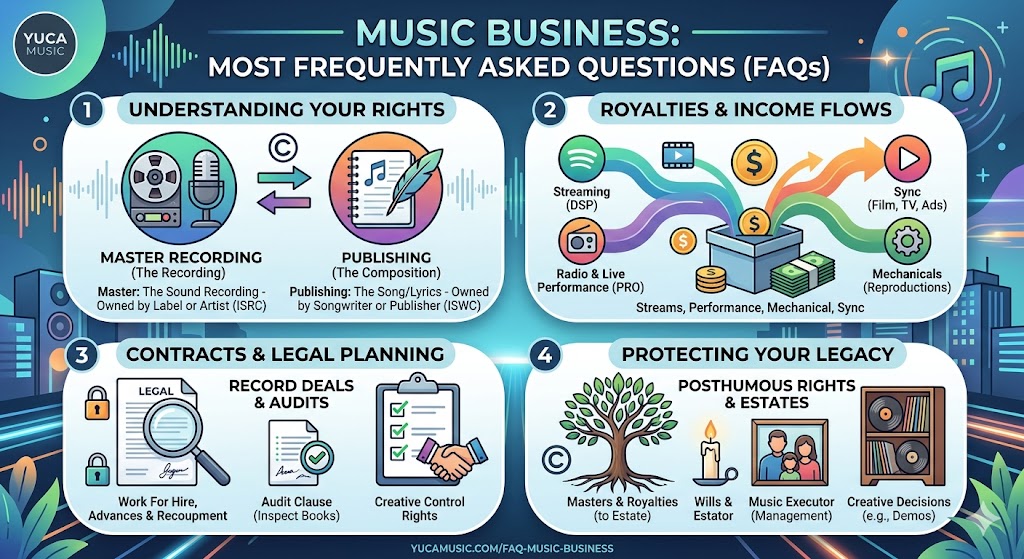
📂 Understanding Music Rights
What is the difference between “The Master” and “The Publishing”?
Every song has two distinct copyrights:
- The Master (Sound Recording): This is the specific audio file of a performance. Usually owned by a record label or the person who financed the recording.
- The Publishing (Composition): This refers to the underlying lyrics and melody. Owned by the songwriters and their music publisher.
What does “owning your masters” actually mean?
It means you own the final audio recording of your music. You have the total right to decide where that recording is sold, streamed, or licensed (e.g., in a movie), and you keep the master-side royalties.
What are ISRC and ISWC codes?
- ISRC (International Standard Recording Code): A unique “digital fingerprint” for your recording.
- ISWC (International Standard Musical Work Code): A unique identifier for your composition (the song itself).
- Both are essential for tracking your music and ensuring you get paid accurately.
💰 Royalties & Getting Paid
How do I earn money from my music?
Revenue generally flows from three main streams:
- Mechanical Royalties: Paid when your song is reproduced (physical sales or digital streams).
- Performance Royalties: Paid when your music is played in public (radio, TV, live venues, or streaming services).
- Sync Licensing Fees: A one-time fee paid when your music is used in “sync” with visual media like films, ads, or video games.
What is a PRO (ASCAP, BMI, SESAC)?
A Performing Rights Organization (PRO) collects performance royalties on behalf of songwriters and publishers. If your music is played on the radio or in a restaurant, the PRO ensures the songwriters are compensated.
Why am I not seeing royalties from my streams yet?
Streaming services typically pay out on a “streamshare” model, and there is often a 3-to-9 month delay between a stream occurring and the royalty appearing in your account due to processing times between DSPs, PROs, and publishers.
🕊️ Legacy & Estate Planning
What happens to my music rights if I pass away?
Your music is a piece of intellectual property that becomes part of your Estate. While a label may still own the masters, your contractual right to receive royalties passes to your heirs or beneficiaries. Your estate’s executor will then manage these assets [Turn 1, Turn 2].
Can unreleased music be released after an artist’s death?
Generally, yes. Most record contracts include a “Successors and Assigns” clause that allows the rights-holder (the label) to continue exploiting recordings made during the contract term, provided they continue paying royalties to the artist’s estate [Turn 1].
What is a “Key Person” insurance clause?
This is a clause where a label takes out a life insurance policy on an artist. Because the artist is a major financial investment, the policy helps the label recoup its costs if the artist passes away unexpectedly [Turn 1].
📝 Contracts & Legal
What is a “Work Made for Hire”?
Under this agreement, the creator (you) gives up all ownership of the copyright to the person or company hiring them (the label). In the US, this usually means the label owns the copyright for 95 years from publication.
What is an “Audit Clause”?
An audit clause gives you the legal right to hire a professional to inspect the record label or publisher’s books to ensure you have been paid accurately.
Who owns the masters of a song?
Typically, the person or entity that paid for the recording session owns the masters. In a standard record deal, this is the record label. In an independent setup, it is the artist.
How long do master rights last?
In the United States, for works created after 1978, the copyright for a master recording (a “work made for hire”) generally lasts 95 years from the date of publication or 120 years from the date of creation, whichever expires first.
Is “Mastering” the same as “Masters”?
No. Mastering is the technical process of polishing a mix to prepare it for distribution. The Master is the final result of that process.
Summary Table: Masters vs. Publishing
| Feature | Master Recording (The Master) | Musical Work (Publishing) |
|---|---|---|
| What it is | The specific audio file/performance | The song’s lyrics and melody |
| Typical Owner | Record Label or Artist | Songwriter or Music Publisher |
| Revenue | Sales, Streams, Sync (Master side) | Performance, Mechanical, Sync (Pub side) |
| Creation | The Studio Session | The Writing Session |
Export to Sheets
Looking for more information on how to protect your rights? Contact our publishing team to learn how we help artists manage their legacies.